Minor Accidents
Low-Speed Accidents: Why Minor Impacts Can Cause Serious Injuries
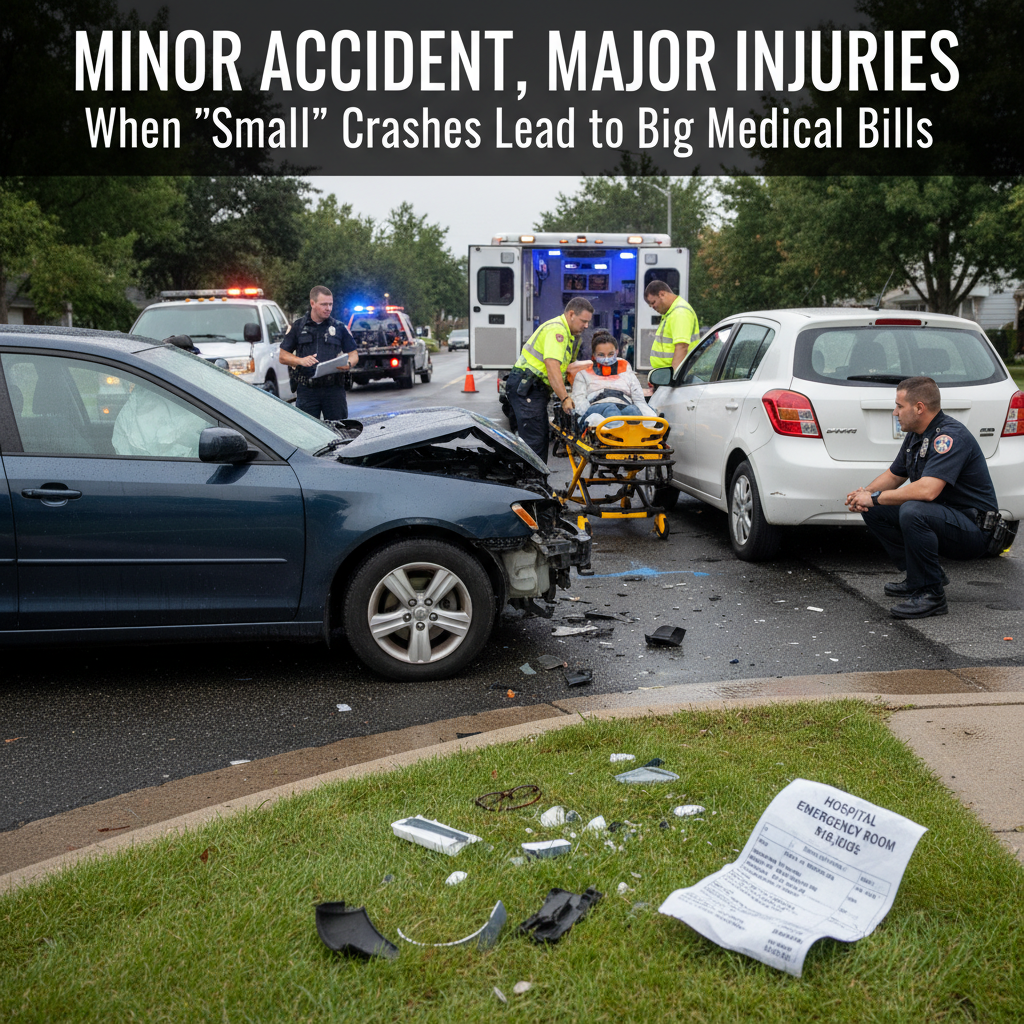
The insurance adjuster looks at photos of your barely-dented bumper and declares: "There's no way you were seriously injured in such a minor accident." But biomechanics research proves vehicle damage and injury severity don't correlate. Low-speed impacts routinely cause herniated discs, concussions, and permanent impairment.
The Science: Vehicle Damage ≠ Injury Severity
Modern vehicles are designed with crumple zones that absorb impact energy to protect the vehicle structure. This means low-speed collisions can produce minimal vehicle damage while transferring significant force to occupants' bodies. Research shows impacts as low as 5-8 mph routinely cause whiplash, herniated discs, and concussions. Factors that increase injury risk in low-speed collisions: occupant wasn't braced for impact, head was turned, pre-existing spinal vulnerabilities, rear-end configuration (worst injury mechanism), and vehicle weight differential. The insurance industry's "minor damage = minor injury" argument ignores established biomechanics science and is routinely defeated with expert testimony.Common Myths About Low-Speed Accidents
Myth #1: Minor Vehicle Damage = Minor Injuries
If the vehicles barely have a scratch, you couldn't have been hurt badly.
Reality: Vehicle damage and occupant injury are not correlated. Modern bumpers are designed to prevent cosmetic damage at low speeds, but occupants' necks and spines are still subjected to rapid acceleration-deceleration forces. Studies show 42% of occupants in collisions with less than $1,000 vehicle damage report injuries lasting more than 6 months.
Myth #2: You Can't Get Whiplash Below 10 mph
Whiplash only occurs in high-speed collisions. If the crash was under 10 mph, whiplash is impossible.
Reality: Biomechanics research demonstrates whiplash injuries occur at impacts as low as 5 mph. The head's rapid forward-backward motion (whiplash mechanism) happens regardless of vehicle speed. In fact, unexpected low-speed impacts where the occupant isn't braced often cause worse whiplash than higher-speed collisions where the occupant tensed their neck muscles in anticipation.
Myth #3: If the Airbags Didn't Deploy, It Wasn't Serious
Airbags only deploy in serious accidents. If they didn't go off, you couldn't be seriously injured.
Reality: Airbags deploy based on deceleration thresholds (typically 8-14 mph for frontal impacts, 5-7 mph for side impacts). Many serious injury collisions occur below these thresholds. Herniated discs, concussions, and soft tissue injuries routinely occur in accidents where airbags don't deploy.
Myth #4: Older/Cheaper Cars Sustain More Damage = Less Injury
If your older car has more visible damage than the newer car that hit you, you must be more injured than the other driver.
Reality: Older vehicles without modern crumple zones may show more damage precisely because they absorb less energy—meaning more force is transferred to occupants. Vehicle damage patterns tell you nothing about injury severity to the people inside.
The Biomechanics: How Low-Speed Impacts Cause Injury
Why Your Neck Gets Injured While Your Car Doesn't
The whiplash mechanism: In a rear-end collision, your vehicle is pushed forward. Your torso (attached to the seat) accelerates forward, but your head (not attached to anything) lags behind due to inertia. This creates hyperextension—your head snaps backward. Milliseconds later, your head rebounds forward into hyperflexion. This rapid extension-flexion motion happens in 100-150 milliseconds. The forces involved: Even at 5-8 mph, your head experiences 2-3 G-forces of acceleration. Your neck muscles aren't designed to resist these forces. Ligaments stretch, discs compress, facet joints jam together. The injury occurs before your neck muscles can react to stabilize your head. Why vehicle damage is irrelevant: Modern bumpers are designed with energy-absorbing structures that prevent cosmetic damage up to 5-10 mph impacts. The bumper crumples, absorbs energy, and prevents damage to the vehicle body. But your neck has no such crumple zone. The same forces that are harmlessly absorbed by a $2,000 bumper assembly are transmitted directly to your cervical spine.Risk Factors That Increase Injury in Low-Speed Collisions
Unexpected Impact
When you don't see the collision coming, your neck muscles are relaxed. Braced muscles provide some protection. Unexpected impacts allow full whiplash motion, increasing injury severity.Head Position
Head turned to the side, looking back to change lanes, or tilted forward looking at phone significantly increases injury risk. Asymmetric head position creates lateral forces on cervical spine.Gender Differences
Women have higher injury rates in low-speed collisions due to smaller neck muscle mass and different cervical spine geometry. This is established biomechanics, not speculation.Age and Pre-Existing Degeneration
Older occupants with degenerative disc disease are more vulnerable to disc herniation in low-speed impacts. Under eggshell plaintiff doctrine, this doesn't reduce liability—it explains why injury occurred.Seat Position
Headrest position matters enormously. If headrest is too low or too far back, it fails to prevent hyperextension. Properly positioned headrest reduces whiplash injury by 40-50%.Vehicle Weight Differential
When a heavy SUV rear-ends a compact car at 8 mph, momentum transfer is significant. The lighter vehicle experiences greater acceleration, subjecting occupants to higher G-forces despite low collision speed.Common Injuries in Low-Speed Collisions
Whiplash and cervical strain: The classic low-speed injury. Soft tissue damage to neck muscles, ligaments, and facet joints. Can resolve in weeks or become chronic pain lasting years. Herniated cervical discs: Low-speed rear-end impacts routinely cause disc herniations. The rapid compression and shearing forces on the disc during whiplash motion can rupture the outer annulus, allowing disc material to herniate. Settlements: $75,000-$250,000+ depending on treatment required. Concussions and mild TBI: The brain's impact against the inside of the skull during rapid deceleration can occur at speeds as low as 6-8 mph. Concussion doesn't require head impact with external object—just rapid acceleration-deceleration. Thoracic outlet syndrome: Compression of nerves and blood vessels between neck and shoulder, often from seatbelt forces combined with whiplash motion. Causes arm pain, numbness, and weakness. TMJ (jaw) injuries: Whiplash forces can injure the temporomandibular joint, causing chronic jaw pain, clicking, and difficulty chewing. Often missed initially because symptoms are delayed. Shoulder injuries: Seatbelt forces in low-speed collisions can tear rotator cuff tendons. Vehicle doesn't need significant damage for seatbelt to cause shoulder injury.🚨 Never Accept "Your Injuries Don't Match the Damage"
Insurance adjusters are trained to use the MIST defense: Minor Impact, Soft Tissue. They'll point to minimal vehicle damage photos and claim your herniated disc or concussion is impossible. This is junk science designed to deny claims. Counter this with biomechanics expert testimony. Your expert reviews the collision dynamics, vehicle weights, impact configuration, and your injuries, then opines: "The forces generated in this collision were more than sufficient to cause the injuries sustained. Vehicle damage is not a reliable indicator of occupant injury severity. The claimant's injuries are consistent with established biomechanics principles for rear-end collisions at this speed."Defeating the MIST Defense
1. Biomechanical expert testimony. Retain an expert (often an engineer with biomechanics specialization) who can analyze the collision and explain why your injuries are consistent with the forces involved, regardless of vehicle damage. 2. Medical causation opinion. Your treating physician or independent medical examiner opines that the collision caused your injuries. The mechanism (rear-end) is consistent with the injury pattern (cervical disc herniation). 3. Published research. Include studies in your demand package showing low-speed collisions cause the specific injuries you sustained. The medical literature overwhelmingly supports that 5-10 mph impacts cause whiplash, disc herniations, and concussions. 4. Temporal relationship. Symptoms began immediately after or within 24-72 hours of the accident (normal delayed onset pattern). No other explanation exists for sudden injury onset. 5. Prior health status. Medical records showing you were asymptomatic before the accident. No prior complaints of neck pain, headaches, or other symptoms that suddenly appeared post-accident. 6. Accident reconstruction if necessary. In high-value cases, an accident reconstructionist can calculate the exact forces, accelerations, and vehicle dynamics to prove injury-causing forces were present.
"The 'minor damage, minor injury' argument is insurance company pseudoscience. I've reviewed hundreds of low-speed collision cases. Five mph rear-end impacts routinely cause C5-C6 disc herniations requiring surgery. The physics is clear: vehicle crumple zones absorb impact energy, but human necks don't have crumple zones. When insurers claim 'the damage doesn't support the injury,' they're betting you won't hire a biomechanics expert. Once you do, their defense collapses."